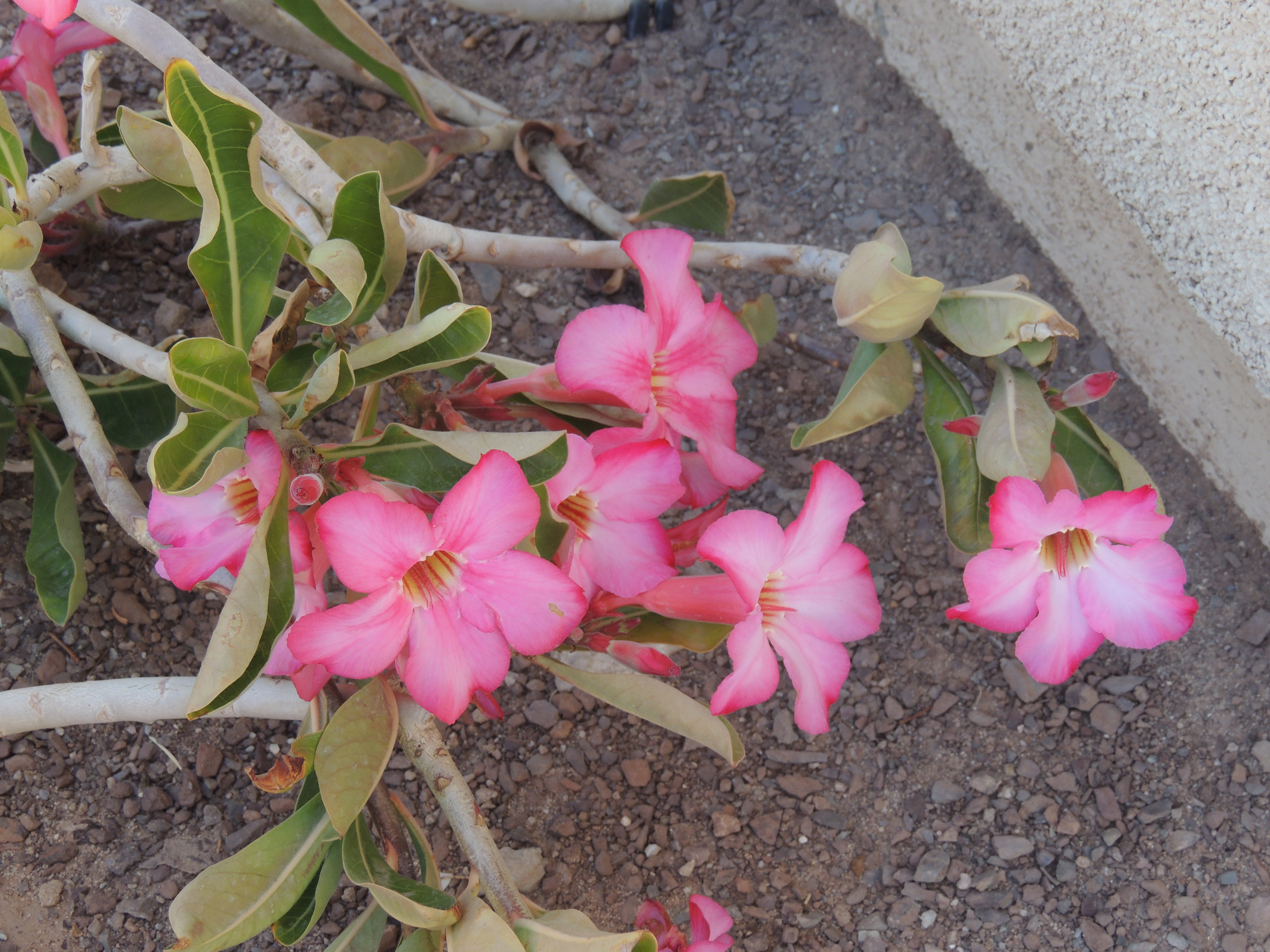
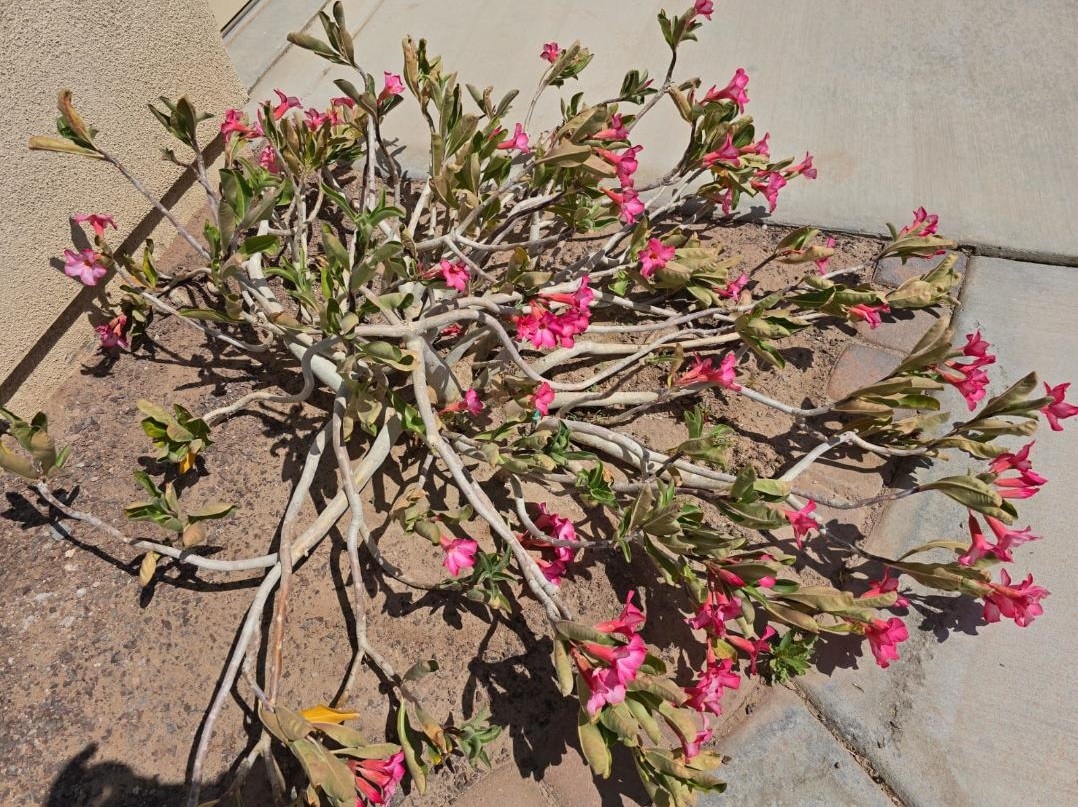
Wild adeniums are found in arid regions of Africa and the southern Arabian Peninsula. Several varieties can withstand cooler temperatures while others freeze easily. Each variety differs in growth, characteristics and flowers. Adenium obesum is the most common variety grown as a houseplant and is often for sale at Lowe’s or Target.
A Desert Rose relies on its toxic sap, similar to an oleander, for defense against predators. Its leaves are not thick like most succulents and have different shapes, depending upon the variety. Some varieties drop their leaves in winter while others are evergreen.
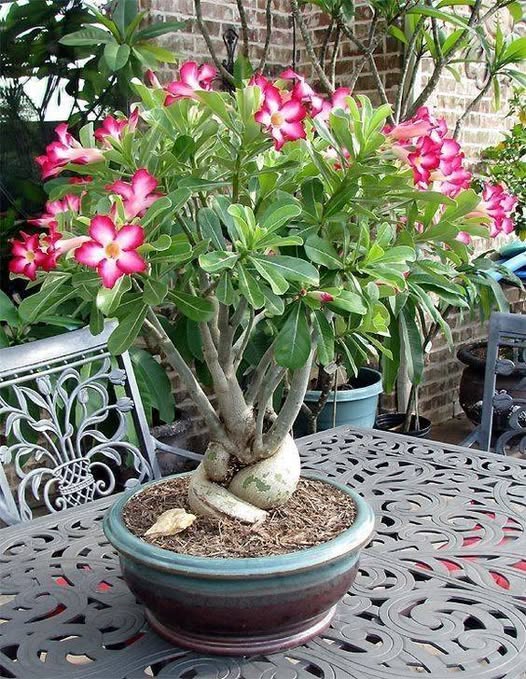
In our warm climate, a Desert Rose is best grown in a container where it can stay outdoors during spring and summer and be moved indoors during winter when temperatures cool since it cannot tolerate temperatures below 50 degrees. A terra cotta pot is best because it is porous to provide some air circulation and allows the soil to dry out faster so the roots do not rot.
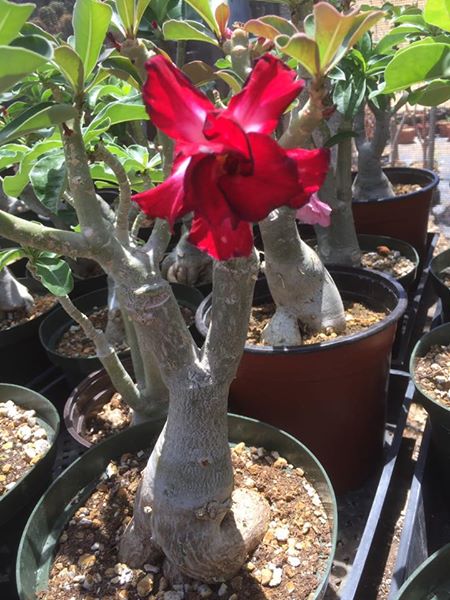
A Desert Rose is best grown in a shallow pot where more of the caudex (trunk) is exposed to encourage blooming. You rarely repot a mature plant. Moving the plant to a location with filtered light or morning sun and afternoon shade during the hottest summer months will prevent any sunburn on its leaves or trunk.
Do not plant a Desert Rose in a container larger than its root ball because the extra soil will hold too much water which might rot the roots. When you replant a Desert Rose, which is rare, use only a slightly larger pot than the one it is growing in. Raise its woody trunk 1-2 inches higher when repotting to show off its unique, bulbous shape.
Although a Desert Rose stores water, it should be watered regularly when not dormant. Wait for the soil to dry completely before watering. Proper drainage is critical for a healthy plant to prevent its roots from rotting.
The plant’s growing season is from April to October. During this time, fertilize every two weeks with a balanced liquid fertilizer (16-16-16) or use a granular fertilizer that is diluted to half its strength. When the plant begins to bloom, use a high phosphate fertilizer, such as Hawaiian Bud and Bloom (5-50-7).
The plant will go dormant during winter months and drop its leaves. Bring the plant indoors and stop watering and fertilizing. A Desert Rose needs cooler temperatures to go dormant. Indoors, if its leaves do not drop in winter because your house is too warm, withhold water to force the leaves to drop and dormancy to begin.
In March, when temperatures warm, place your plant outdoors in a location that is shaded and gradually give the plant more sun each day until it is acclimated and can withstand morning sun and afternoon shade.
A mature plant will flower from late winter through spring, usually before it grows new leaves. Its lovely, five-petaled flowers come in a multitude of colors, depending upon the variety. In spring, prune, as needed, to maintain correct shape. Cuttings can be rooted by dipping the cut end in a rooting hormone and letting it dry several days before planting in a well-draining soil. Place the cutting and its pot inside a large plastic bag to help increase humidity. In about six weeks, the
cutting should be rooted and can be removed from the plastic bag. If you are looking for an unusual plant, try growing a Desert Rose.
By Karen Bowen, Blog Manager