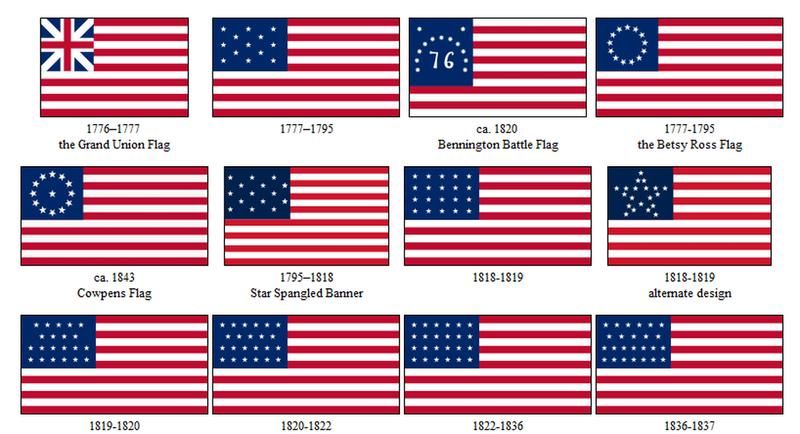
June 14 is Flag Day when we honor the adoption of the first standard flag representing the United States of America. This occurred on June 14, 1777, when a resolution signed by the Second Continental Congress stated, “The flag of the thirteen United States be thirteen stripes, alternate red and white; that the union be thirteen stars, white in a blue field representing a new constellation.” Red, white and blue were the colors adopted for this standard flag, with white signifying purity and innocence, red signifying hardiness and valor, and blue signifying perseverance and justice. Thirteen stars represented the thirteen original colonies.
Before the standard flag was adopted, a committee formed by the Second Continental Congress in 1775 created an unofficial flag design called the Grand Union Flag. The committee, consisting of Benjamin Franklin, Benjamin Harrison and Thomas Lynch, designed a flag with thirteen red and white stripes representing the thirteen original colonies with a field of blue in the upper left corner that included the British Union Jack flag, a red cross representing St. George of England and St. Andrew of Scotland. The British Union Jack was added to the left corner design as a show of respect for England, although the Revolutionary War was about to begin where America fought England for its independence. The Grand Union Flag was flown as the unofficial flag of America throughout the American Revolutionary War.
The 1777 Flag Resolution standardized the number of stripes and stars on the flag but gave no specific information as to the arrangement of the thirteen stars. This led to a variety of different star designs being used. The arrangement of the stars depended upon the state’s wishes and the person making the flag. When two new states the United States, Vermont in 1791 and Kentucky in 1792, two more stripes and two stars were added to the flag, making fifteen stripes and fifteen stars, with three stars in each row.
In 1818, when five more states were added to the United States, making 20 states, Congress enacted the third and last Flag Resolution stating that “Henceforth, the number of stripes should remain thirteen red and white stripes, the number of stars should match the number of states, and any new star should be added on July 4th following that state’s admission.” This resolution has been followed ever since, with Hawaii becoming our 50th state.
On Fourth of July, America’s 250th birthday, may we proudly wave our American flag.
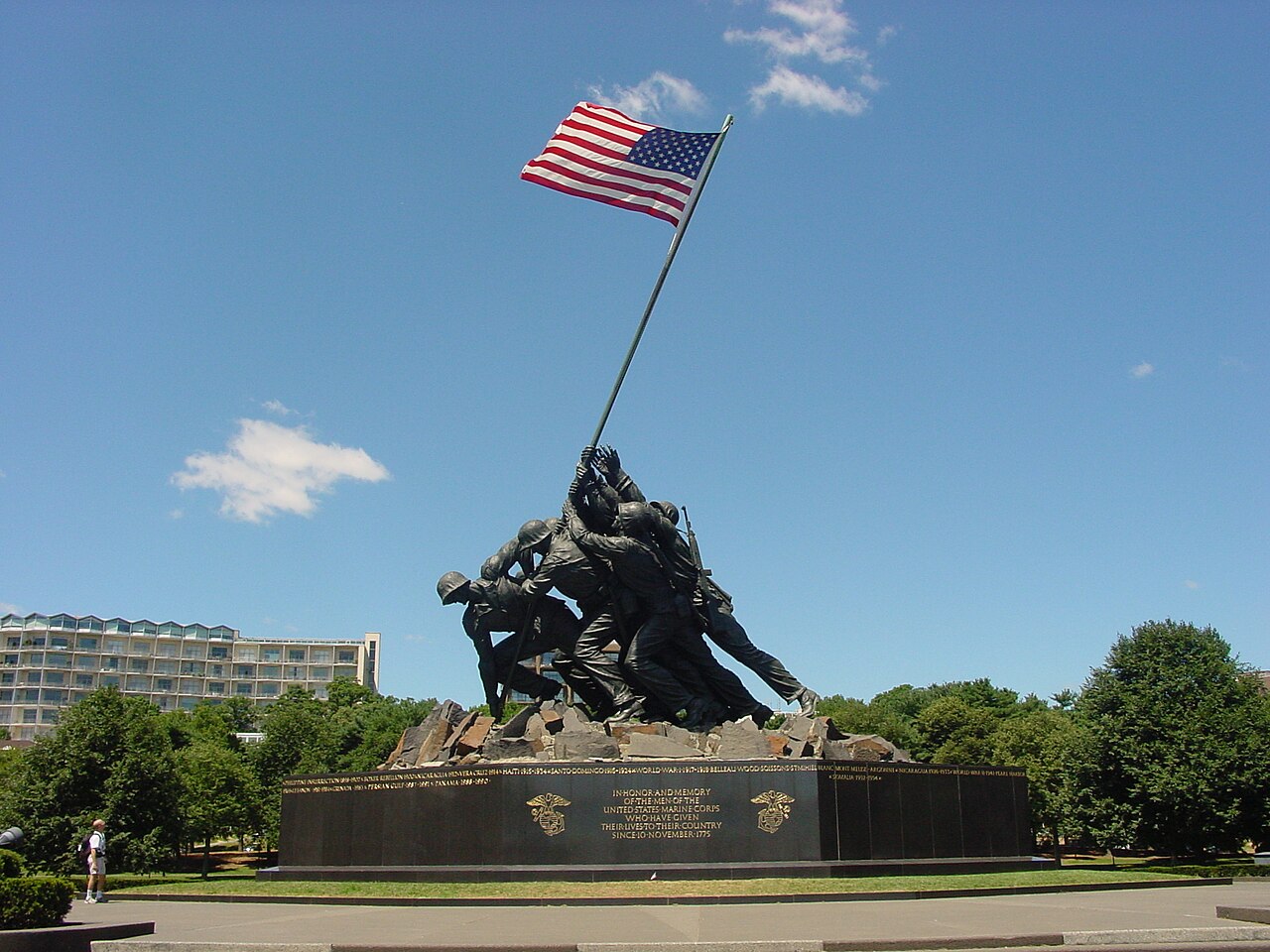
Marine Corps War Memorial, Arlington Ridge Park, Arlington, Virginia