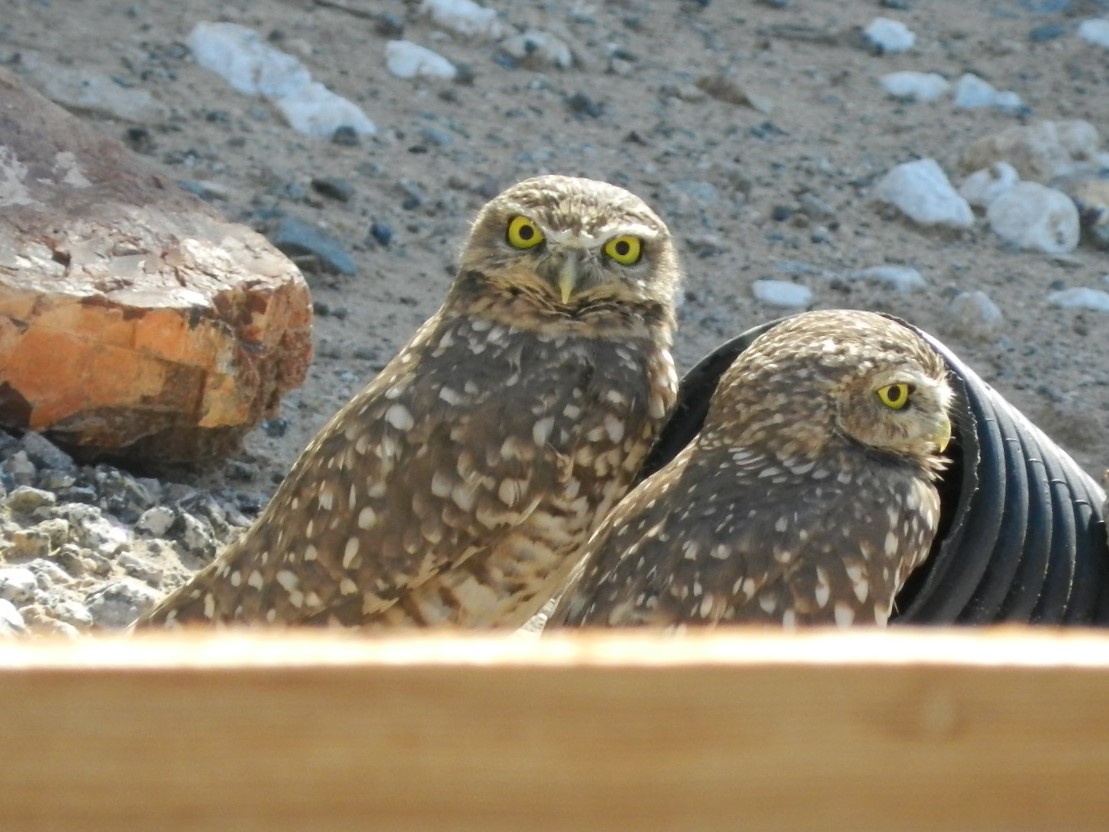
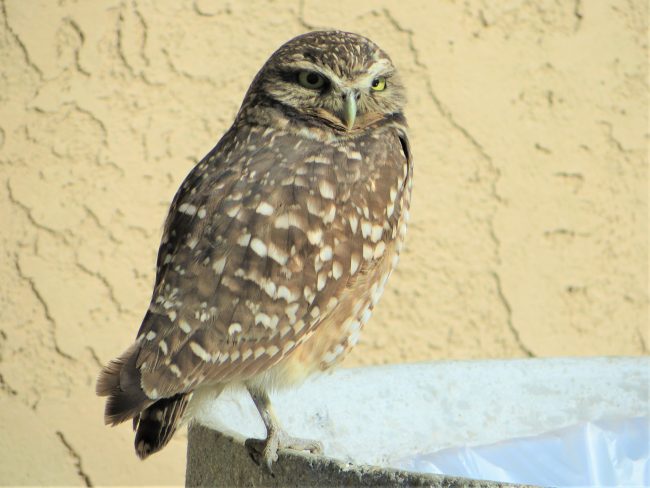
Burrowing Owl populations have declined due to habitat loss from land development. In the U.S., they are not listed as “endangered” but are listed as a “species of concern”. This long-legged owl’s piercing, yellow eyes carefully watch for prey as it silently stands guard outside its underground burrow. It lives in a burrow abandoned by a ground squirrel, skunk, badger, kangaroo rat, or prairie dog.
The burrow is around six feet long, with a larger cavity at the end of the tunnel used by the female to lay her clutch of eggs. The male lines the nest with dried plants, feathers and dry dung. Dry dung also lines the entrance to the burrow and is thought to serve two purposes: to mask the birds’ scent to keep predators away and to attract insects for food.
The female sits on her eggs for about a month. During that time, the male brings food to the female. Once the eggs hatch, the male feeds the female and the chicks for another two weeks until the chicks are old enough to remain in the nest while both parents hunt for food to feed them. Six weeks after hatching, the chicks are ready to leave the nest and forage for themselves.
There are 22 subspecies of Burrowing Owls found in southern Canada, Florida, the Caribbean, Mexico, Central America, South America and throughout the western states. This unusual owl, unlike other owls, does not hunt for food at night, but hunts during the day. Its mottled brown and white feathers are perfect camouflage as it stands on the ground or a fence post looking here and there for a rodent or lizard to snatch for a meal.
Its head turns 270 degrees due to fourteen neck bones. This allows the owl to keep a close watch for prey in all directions. In contrast, humans have only seven neck bones and a limited turning range of only 180 degrees. The owl’s varied diet includes insects, small snakes, lizards, mice, frogs, and songbirds. If food is plentiful, it will make a cache of dead mice or snakes in its burrow to eat when food is scarce.
Predators include badgers, house cats, skunks, dogs, coyotes, snakes, bobcats, Great Horned Owls, and Red-Tailed Hawks. Burrowing owls hide in their burrows when threatened and make a sound that imitates a rattlesnake’s rattle to scare off predators.
Burrowing Owls are not picky about where they live and can even be found on golf courses, near airports, along dirt canals, and next to roadways where busy traffic rushes by. They will also live in artificial burrows made from a plastic bucket for the nest and PVC pipe for the tunnel leading to the nest. Wild at Heart Burrowing Owl Recovery Project in Phoenix makes artificial burrows and relocates burrowing owls from construction sites to help conserve Arizona’s Burrowing Owls.
The health and welfare of the Burrowing Owl is of importance to our own health and welfare. This important bird helps control the rodent population in many areas to reduce the spread of diseases carried by rodents to humans, such as Hantavirus. A family of Burrowing Owls can eat 7,000 insects and 1,800 rodents in one season, making them an important link in our food chain.
Keep your eyes open when driving through the desert, you might spy a Burrowing Owl standing watch outside its burrow as you drive by.
By Karen Bowen, Blog Manager